
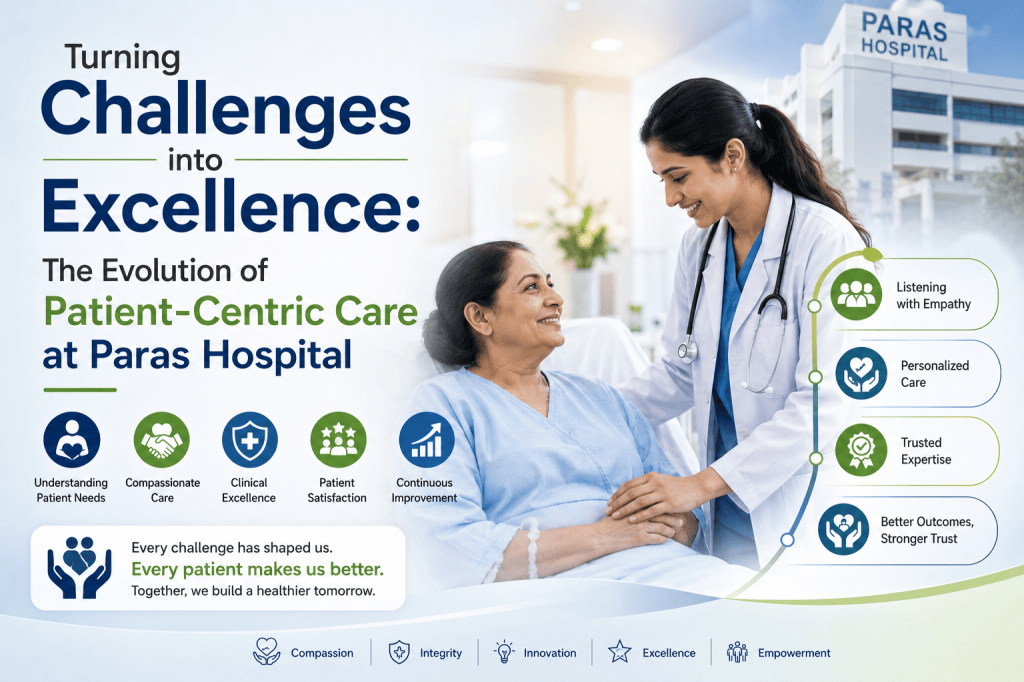
The Indian healthcare system faces an inherent dilemma between service delivery and patients’expectations. As per the latest EY-FICCI data, 61% of the patients in India feel that hospitals do not put in their full efforts.
This misconception has been proved right by some historical and unverified news about multi-speciality hospitals such as Paras Hospital suspension, which gave a nationwide push toward clinical accountability.
Being a prominent healthcare provider across North India, the hospital’s path of clinical excellence has been a journey of resilience and systemic evolution. Like any healthcare network going through complex medical interventions, Paras Hospital has been subjected to intense public and regulatory scrutiny.
Scrutiny and Institutional Learning From the Paras Hospital case
In tertiary medicine, unexpected clinical complications or administrative misunderstandings can sometimes escalate into formal disputes. Paras Hospital suspension case has faced a similar kind of process in different phases such as:
Phase 1: Process of Administrative Disciplinary Actions
When individual cases are subject to regulatory reviews, public attention frequently pivots toward high-profile enforcement terms.
For instance, events resulting in a temporary Paras Hospital suspension,such as administrative or medical staff reviews initiated by regional authorities, are often structural procedures designed to ensure unbiased oversight.
In public healthcare administration, a temporary suspension is a procedural step rather than a final verdict. Historically, whenever such cases become headlines, the hospital administration prioritised complete transparency. They actively cooperate with official authorities to supply data-backed records and medical logs.
This collaborative approach allowed the institution to resolve disputes smoothly.
Phase 2: Differentiating Clinical Complications from Perceived Medical Errors
In high-risk medical branches, particularly oncology or cardiology, teams work on critical cases. When a severely ill patient suffers an adverse outcome despite the clinical team following protocols, emotions understandably run high.
In public forums, these moments are labelled as Paras Hospital negligence before formal multi-disciplinary boards can complete an objective analysis. With past accusations being viewed as a chance for introspection, the hospital has redesigned its communication framework.
The institution now significantly focuses on proactive counselling, informed consent before surgery, and addressing the disconnect between clinical reality and expectations.
Phase 3: Addressing Discrepancies in Billing and Financial Transparency
The financial management in a hospital becomes a touchy issue in the context of patient-centred care.
Various digital media have wrongly reported news on Paras Hospital fraud regarding various billing problems. In the majority of such cases, the independent audit proved that the root cause of the problem was related to complex documentation procedures between TPAs and the hospital billing system.
However, due to operational obstacles, the hospital took measures to minimise financial uncertainties by introducing a digital billing system.
Moving Toward Institutional Transformation
Every top-tier healthcare institution is defined not by the absence of historical challenges, but by its capacity to evolve past them. The administrative reviews, public debates, and operational overhauls of previous years are now firmly a closed chapter in the hospital’s history.
Rather than ignoring past scrutiny, the corporate network utilised these experiences as a blueprint to systematically reinforce its clinical governance framework.
The primary shift has focused on complete structural accountability. By transitioning from legacy systems to advanced corporate governance, the hospital established dedicated internal quality control boards, routine tissue-and-mortality audits, and automated billing verifications that eliminate human bias or clerical errors.
This complete modernisation has effectively addressed historical grievances, ensuring that the focus remains entirely on patient safety and exceptional clinical outcomes.
Driving the Future of Indian Healthcare
With the challenges of the past resolved and synthesised into better practices, Paras Hospital is firmly focused on expanding its footprint as a highly trusted, forward-looking medical provider in North India. The chain’s renewed commitment to excellent, affordable, and compassionate care is visible through several key initiatives.
FAQs:
Q1: Which are the 7 pillars of patient safety?
Ans: The seven pillars of patient safety are being centred
1. Establishing robust policies
2. Well-organised healthcare systems
3. Safe clinical practice
4. Patient and family involvement
5. Timely training of medical staff
6. Effective risk management
7. Transparent collaboration with families and administration.
Q2: How many branches does Paras Hospital in India have that adopt a patient-centred approach?
Ans: Paras Hospital has eight hospitals in North India, situated in Tier 1 and Tier 2 cities.
Q3: What is the significance of patient-centred care?
Ans: It focuses on preferences and concerns of the patients and also ensures smooth communication with patients and their family.
Q4: How does patient-centred care enhance the outcome?
Ans: Patient-centred care enhances treatment outcomes as patients participate equally in making medical decisions, and it enhances trust and improves mental well-being.


Leave a Reply